

Mesothelioma education and support
What Is Mesothelioma?
Mesothelioma is a rare cancer most often linked to asbestos exposure. This page explains the basics in plain language, including pleural lining information, symptoms people commonly research, and why exposure history matters.
Plain-English mesothelioma education
Mesothelioma is a rare cancer that develops in the mesothelium, the thin lining around certain organs. Most cases are associated with prior asbestos exposure, often many years before symptoms appear.
This page explains the basic forms of mesothelioma and how asbestos fibers may be connected to disease development over time.
Mesothelioma overview
Mesothelioma is a cancer that develops in the mesothelium, which is the thin protective lining around certain organs and body cavities. The mesothelium helps organs move smoothly inside the body. When cancer develops in this lining, it can affect the lungs, abdomen, heart lining, and other nearby tissues depending on the type of mesothelioma involved.
The most common form is pleural mesothelioma, which affects the lining around the lungs, called the pleura. Because this area is close to the lungs and chest wall, symptoms may include chest discomfort, shortness of breath, cough, fluid buildup, fatigue, or unexplained weight loss. These symptoms can also be caused by many other conditions, so medical evaluation is important.
Another form is peritoneal mesothelioma, which affects the lining around the abdominal organs, called the peritoneum. Symptoms may include abdominal swelling, pain, digestive changes, loss of appetite, or unexplained weight loss. Less common forms may involve the lining around the heart, called the pericardium.
Most mesothelioma cases are associated with prior asbestos exposure. Asbestos fibers can become airborne when asbestos-containing materials are disturbed, damaged, cut, sanded, removed, or demolished. Once inhaled or swallowed, fibers may remain in the body for many years. Over time, these fibers may contribute to irritation, scarring, cellular changes, and disease development.
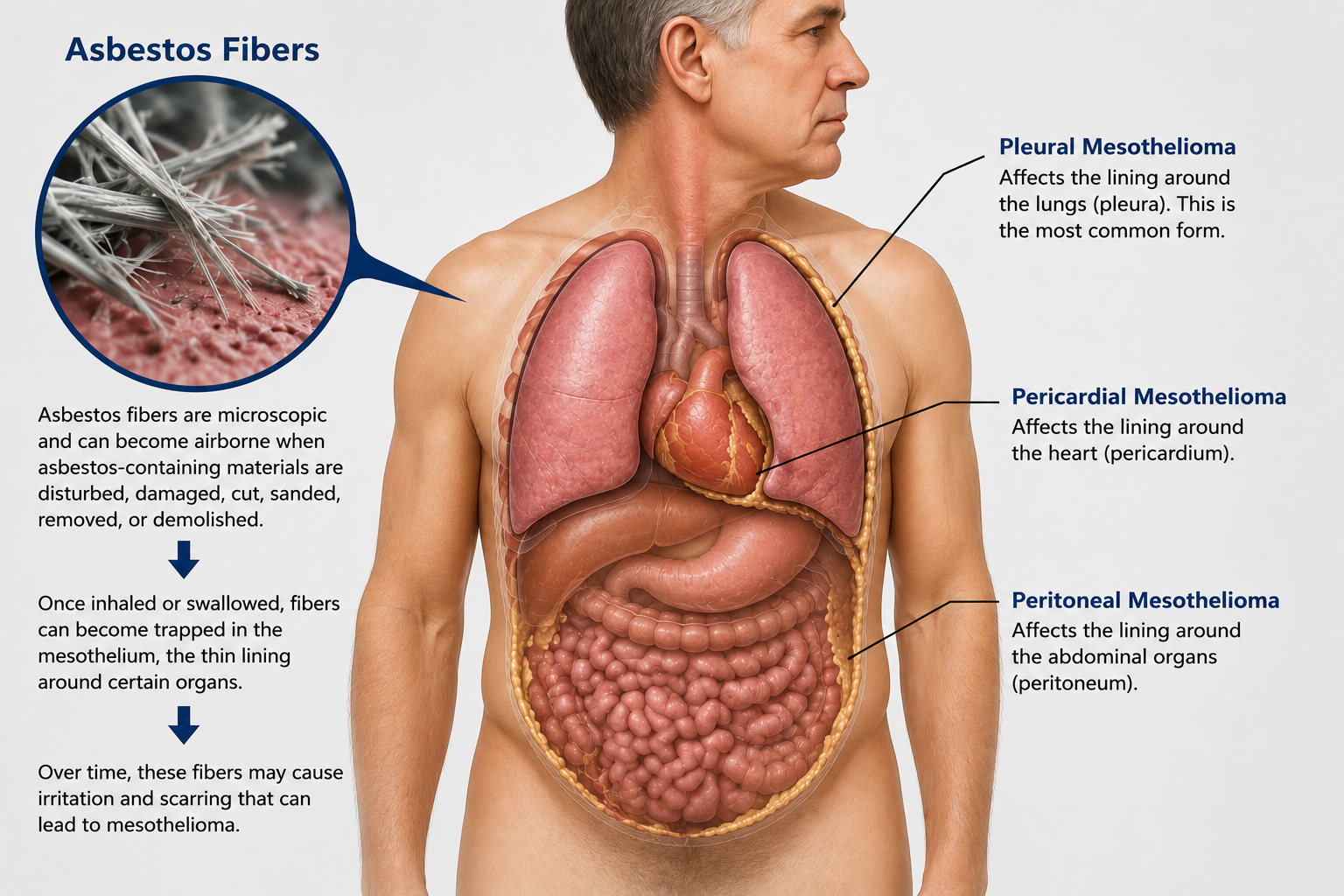
How asbestos exposure connects to mesothelioma
Asbestos exposure usually becomes a concern when microscopic fibers are released into the air and inhaled or swallowed. This can happen during construction, demolition, renovation, industrial maintenance, shipyard work, boiler work, insulation work, floor tile removal, or disturbance of older building materials.
The body may not be able to fully remove some fibers after exposure. Fibers can become lodged in tissue and may remain there for many years. The risk can be influenced by exposure intensity, duration, fiber type, work practices, and whether protective controls were used.
Related educational topics
Reminder: This content is for general education only. MesotheliomaClaims.us is not a law firm, does not provide legal advice, and does not provide medical advice.